Taiwan's FREE resource for 50+
materials, methods & Editorials

Professional Development Training
Exam Preparation (TOEFL, IELTS, TOIEC)
Get a consultation

Editorials   Material


Business Material Menu
Student Material Menu
Entertainment Material Menu
Methods Material Editorials About Us Contact Us

The FarWest Method is a foreign language self-teaching system and completely free. Using the Method, you will choose goals, identify your gaps (mistakes), build your own English learning material, and find free online resources that are useful to you.

The FarWest Method was designed to address the 5 Reasons Why Training Fails. It takes into account the structure of the English language and how the brain learns languages.


Far West Method

1. CHOOSE YOUR GOALS

2. IDENTIFY YOUR GAPS + ACQUIRE MATERIAL

3. MEMORIZE NEW MATERIAL

4. PRACTICE NEW SKILLS

5. IMPLEMENT IN YOUR LIFE


1.Choose your Goals

We are going to divide your goals into two types: Life Goals and English Goals.

Life goals are big goals that don't directly involve English.

For example:


•"I want to get a promotion."
•"I want to communicate better with my foreign friends."
•"I want to help my children to be successful."
•"I want to travel."

English Goals are the tools you need to accomplish your Life Goals.

[picture]

While your Life Goals can be general, your English Goals must be specific.

Some examples include:


•"I want to read medium length emails (5-10 sentences) about work, specifically import and export."
•"I want to have a conversation with my boss about entertainment, specifically sports."
•"I want to give a short speech (5-10 sentences) about work, specifically graphs and charts."

Click here to read more about choosing your Goals
Use this Cheat-Sheet to Quickly Select Your Goals


2.Identify your Gaps

Your gaps (mistakes) are what you need to learn to meet your English goals. The more accurately you identify your gaps, the more efficiently you can meet your goals.


Perform – Perform the activity in your native language. For example, if you want to have a conversation about food, write 5 questions and 5 answers in Chinese about food.

Translate – Translate your Chinese sentences into English. If you have any trouble translating a word or phrase, mark it down in Chinese.

Identify – Identify what you think you know, but you're not 100% sure about. This is the hardest part of the process. There are several ways to do this including online assessments, a private teacher, or a language exchange. Contact FarWest now for a FREE Gap analysis [link] Record – Record all your gaps on a Gap Sheet. This will become the core of your learning material.

Read more advice about Identifying Your Gaps
Download a Gap Sheet


3.Memorize New Material

i.Short-Term Memorization

New Vocabulary - There are 600,000 to 1 million words in the English language, so you must identify the words that help you accomplish your English Goals.

When memorizing vocabulary:

•Divide your vocabulary into chunks of seven words.
•Make a sentence for each word and memorize the sentence, not the word.
•When you visualize your sentence, think about location, faces, and emotions.
•Memorize for 15 minutes then take a 5 minute break.
•Test yourself for 15 minutes.

Just like with exercising our muscles, we need to force our brains to do a lot of work for short periods of time. Study 7 sentences aggressively for 15 minutes then take a 5 minute break, followed by a 15 minute test.(memorize)

Read more about Memorizing Vocabulary
Download a Memorizing Vocabulary Cheat-Sheet [UNDER CONSTRUCTION]

ii.Super-Useful Phrases

Memorizing phrases is a lot like memorizing vocabulary. However, there is a key difference.

Super-Useful phrases involve those 100 words that make up 50% of the English language. They are extremely useful but also extremely hard to remember. The reason is those words usually have no direct translation and no direct meaning. For your brain, this makes them seem useless so your brain decreases their priority.

You need to associate these 100 words with something your brain will remember – food or animals. For example, you could associate "an" with "ant" or "on" with "orange."

These should be personal. If you choose them yourself, they will be easier to remember. The associations should be made once and memorized.

Click here to read more about Memorizing Super-Useful Phrases [UNDER CONSTRUCTION]

iii.Long-term Memorization

We can memorize information quickly but we also forget information quickly. Luckily, modern marketing techniques give us methods to acquire and reinforce these memories.

We can reinforce memories by:


•Changing our desktop wallpaper to English sentences we want to remember
•Hanging signs in our room or beside our desk at work
•Listening to an MP3 of the sentences we want to remember

Reinforcement and acquisition are useful. However, sometimes we need to do a detailed review. Modern psychology suggests that this should be done every 30 days for maximum efficiency and retention.

Click here to read the Long-Term Memorization


4.Practice New Skills

Practice has many stages:


Absorbtion – Initially using the material that you memorized (ie using a new phrase in a familiar situation)

Mastery – Reaching the level of a native speaker (ie using a learned phrase in any situation)

Maintenance – Keeping your English ready for use (ie occasionally reviewing the phrase through reading or listening)

Click here to read "What is Practice?"

Many students have trouble finding time to practice. In fact, there are many ways to include English in your day without using too much time. The key is creating a schedule for your English practice.

Click here to read some advice about Time Management and Scheduling

The Internet gives us some great opportunities to practice. These days, there are hundreds of English games available for free. They are a fast, fun, and useful way to practice.

In addition, there are lots of free assessments to practice with. They are very useful because they challenge you to think and help you measure your progress.

Click here to read about Games and Assessments


5.Implementing English in your Life

Implementation means using your English in real life. This is where all of your work becomes a reality. There are 4 types of problems that can occur when we implement our English:


Lack of Preparation: When it comes time to use English, some people "panic" and other people "choke."

Lack of Health: Issues like diet and sleep can have a big impact on our performance. Brain health is the key to a good memory and quick thinking.

Lack of Support: Having an English speaker available for back-up can make a huge difference. They can help you with editing as well as a warm-up call before you implement.

Lack of Confidence: Confidence comes with being prepared, good health, and support.

Click here to read the FarWest Implementation Method

Back to Top
Using TED

Ted (www.ted.com) is a website with hundreds of video speeches by today’s leading scientists and business people, including Bill Gates, Tony Robbins, and Al Gore. 


It is also an excellent resource for studying English: 

  1.  If you are a medium or advanced English speaker interested in topics like science, business, medicine, psychology, or history, this could help you. 
  2.  This is also great for people who are preparing for a speech. Some of these videos feature world-famous speechmakers – the very best. You can study their style and technique.
  3.  Finally, this is excellent listening practice for IELTS and TOEFL students. Many of the topics are similar to the listening questions or integrated speaking quations. 
 
Ted has many great tools to assist your learning, including translations and an interactive transcript. Here’s a quick guide to using the videos.


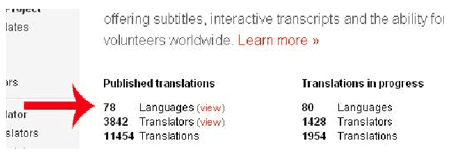
 1. Go to WWW.TED.COM Click on Translations.


2. Choose “Languages (view)”


Select your language. For Taiwan, choose “Chinese (Traditional).” Currently, there are about 466 videos available. 


3. Setting up the Video

You will see a big selection of videos. Choose a topic that is interesting to you i.e. new cell phone technology. When the video loads, you will have several options. You can select different subtitles (ie English) under the video.  You should also click “Open Interactive Transcript” in the top right corner of the screen.


4. Using the Interactive Script

The Interactive transcript allows you to cut and paste text. Or you click on text to listen to that part of the video. You can also change the language of the interactive text to English.


5. Our Advice to you

Everyone’s learning style is different. You should experiment and find the best way for you.

I recommend you try this:

  1.  Change the subtitles to Chinese Traditional
  2.  Change the Interactive Transcript to English
  3.  Read the transcript in English. If you are confused by a section, click to listen to that section and see the Chinese subtitles. Then copy and paste the confusing section into a new file. Later, you can add the Chinese translation to the same file.
  4.  After you have read the transcript in English and checked any confusing words, change the subtitles to English and watch the video again. Now you will have a 100% English experience.  


Click here to go back to our TED video list.


Ted is a useful website that posts hundreds of free speeches by today's leading thinkers.

It's also a great site for practicing English, specifically reading and listening.

Click here to read how to use the Ted Website: Using TED Talks to Learn English

Below is a list of Ted videos recommended by Far West. All of these videos are linked directly to TED.com where you can choose subtitles in English or Chinese and read transcripts in traditional Chinese.

 
Work


Tech


Learning

Back to Top


The Far West Method
The FarWest Method is a foreign language self-teaching system and completely free. Using the Method, you will choose goals, identify your gaps (mistakes), build your own English learning material, and find free online resources that are useful to you. Our was designed to ...

Read More


Business English
Students (Academia)
Fun and Games


Customer Service
What you say to a customer is as important as the actions you take. What are the "red" you should never say? Learn polite phrases and vocabulary to help you overcome your fear of speaking to foreign clients.
Read More

TOEFL Integrated Speaking
TOEFL Integrated Speaking Questions - these questions are very challenging. What format should you use for your answer? How long should you speak for?
This lesson includes advice about TOEFL Speaking 3,4,5 and 6 questions as well as sample answers for each.
Read More

Celebrities
Nowadays, people love to talk about famous people. What vocabulary and phrases can you use? This lesson includes a sample answer, vocabulary, phrases, grammar activities, and real TOEFL speaking/writing questions.
Read More

The Next Day Diary


As with most things, preparation is the key to successful English. One great way to prepare is by writing a "Next Day Diary."

Most people write a diary about what happened before. However, the idea behind the "Next Day Diary" is to write what WILL happen when you implement your English. In other words, write down what you will do and say when you need to use English in the real world.


English Skills

This has several benefits. First, it allows you to foresee English problems that might arise. Writing something out is usually easier than saying it so this will give you a chance to ease into your English.


Confidence

Second, it will boost your confidence. If you notice that you panic or choke before implementing English, this process can really help. By thinking things through, you can release some of your stress and anxiety.


Imagination

Third, writing a "Next Day Diary" stimulates your imagination. Using your imagination exercises your hippocampus, a part of your brain responsible for general memory functions.

English / 中文


學習風格

假設你想要準備一個PowerPoint報告,但有12個單字或詞語是你需要記住的。(這些就是你的“缺口”,一旦你建立了目標,就要開始分析需填補的不足)

首先,將你的材料劃分成7份,心理學家發現7是較容易記住的量-不會太多,也不會太少。

舉例:
其次,我想要造句,並記住這些句子,而非個別的單字。一個句子就是一個故事,跟人一樣,我們的大腦喜歡聽故事。


造一個句子關於:
˙你認識的人
˙你熟悉的地方
˙有點奇怪的事物

如果你擔心你的文法,可以使用字典的例句,並做些小小的改變,讓它變成關於你個人的句子。

舉例:獲利
字典例句:該公司聚焦於他們的獲利。
個人句子:我的朋友,在XYZ公司的比爾,聚焦於他們公司的獲利。

一旦你造了七個句子,你會想要記住它們。為了有效且快速地記憶,你要用你個人的學習方式。

通常有三種學習風格:視覺型、聽覺型,和肌肉感覺型。這些可以相互組合成其他類型,但這三種是最常見的。

視覺型-藉由“看”來學習;聽覺型-藉由“聽”來學習;肌肉感覺型-藉由“動作”來學習。

這怎麼應用在你身上?讓我們想像一個例子:

如果你屬於視覺型的人,你會想要讀這些句子,並想像每一個句子。當你在電腦上打上這些句子時,建議你使用大字體及多種顏色,然後將這些句子放到桌上型電腦的桌面,每當你使用電腦的時候就可以看到它們。

如果你屬於聽覺型的人,你會想要盡可能地多聽這些句子,我建議把這些句子錄在你的手機裡,現今,每支手機都有mp3的錄音功能,所以你可以輕鬆地錄下句子,並在上班途中聽。如果你有家教,可以請他們朗讀這些句子並錄下他們的發音。

最後,肌肉感覺型的人會想要使用他們的手,所以他們會盡可能地重複寫這些句子,他們也會想要對自己大聲唸出這些句子。一般來說,肌肉感覺型的人在學習過程中會想要多點休息。

一旦你覺得自己已經學習了這些句子,別忘了用口說或手寫練習來測驗自己。

English / 中文

選擇一位家教


現今,要雇用一位家教相當容易,但要找到一位好老師卻相當困難。在台灣有幾百,甚至可能幾千個老師,宣稱他們是準備充足,可勝任的英文老師,然而,在這個產業幾年後,我遇到很多未獲得滿足的學生,他們亟需要真正了解這個產業且真正知道成功方法的老師。

不用太過深入,我想跟你分享用來面試一位老師的十個問題。

1. 你的英文教學經驗有幾年?

2. 你會提供所有教材嗎?你是使用什麼樣的教材?你會自己編寫教材嗎?(註:如果老師使用報紙,或依賴你準備教材,很可能是因為他們的經驗不足。)

3. 你會定期指派功課嗎?如果會,你將什麼時候以及怎麼檢查?需要額外收費嗎?

4. 如果我每週購買超過X時數,你願意接受較便宜的費用嗎?(大部份的老師願意降價,如果你購買較多的時數)

5. 有時候我必須取消或延後課程,會有問題嗎?

6. 有什麼好方法可以增進我的聽力能力?

7. 有什麼好方法可以增進我的口說能力?

8. 我的工作相當忙碌且有時候對學習感到非常怠惰,你可以替我規劃一個學習進度表嗎?

9. 你知道任何網路資源,讓我在家可以使用它練習英文?

10. 你建議我們從哪種課程開始?

11. 你有以前學生的推薦信嗎?
 
Back to Top
GETTING STARTED

This Getting Started page is a breakdown of our website - what we offer and what we recommend you try. Click on the icons to read more about a specific topic. At the bottom of the page, you'll find a useful FAQ.


FarWest Method

Click here to start using the Method.

Choose your Life Goals

Choose your English Goal(s)

Discovering your Gaps (what you don't know, as well as your common mistakes)

Find great material that is related to your mistakes

Memorie & Master what you learned Links: Games, Activities, Assessments

Back to Top
 
materialicon Material FarWest consultants have been building customized material for years and all that material is available for free on our site (read our usage policy). Using our FarWest Method, your can select the material that's right for you. We are constantly writing additional material, so check back with us often get see what we have updated!

Our Material topics include: Field-Specific Business English TOEFL IELTS Entertainment Science + Technology Travel and Tourism

Click here to see all of our Material

Back to Top


The Internet is full of English material. Maybe too full. There's a lot of great material but there's a lot of terrible material as well. ATLAS has indexed over 200,000 great English resources online, organized by category, to help you find what you're really looking for. Click here to use the FarWest English Search.

Back to Top
 

Editorials These days, the whole world is learning and speaking English. FarWest has lots of objective (and some subjective) opinions about hiring a teacher, going to cram schools, and global language trends. In addition, we have lots of interviews with teachers and students across Taiwan, sharing their personal experiences overcoming the Chinese/English language barrier.

Click here for an index of our Editorials.

 Back to Top


Games & Assessments The final step to learning English is using what you learn. FarWest has lots of games and assessments to help you use your English. In addition, we recommend some activities you can do with your English friends or teacher.

Click here for an index of our Games.

Back to Top


Frequently Asked Questions

Back to Top


100 out of over 250,000+ words: After running some statistical analysis on the British National Corpus of words we created a list of the most commonly used 100 words in the English language. This list is to help you focus on very common words. It would be very beneficial to know all of these words and how to use them.

1. the 2. of 3. a
           
4. of 5. to 6. in
           
7. is 8. you 9. that
           
10. it 11. he 12. was
           
13. for 14. on 15. are
           
16. as 17. with 18. his
           
19. they 20. I 21. at
           
22. be 23. this 24. have
           
25. from 26. or 27. one
           
28. had 29. by 30. word
           
31. but 32. not 33. what
           
34. all 35. were 36. we
           
37. when 38. your 39. can
           
40. said 41. there 42. use
           
43. an 44. each 45. which
           
46. she 47. do 48. how
           
49. their 50. if 51. will
           
52. up 53. other 54. about
           
55. out 56. many 57. then
           
58. them 59. these 60. so
           
61. some 62. her 63. would
           
64. make 65. like 66. him
           
67. into 68. time 69. has
           
70. look 71. two 72. more
           
73 write 74. go 75. see
           
76. number 77. no 78. way
           
79. could 80. people 81. my
           
82. than 83. first 84. water
           
85. been 86. call 87. who
           
88. oil 89. its 90. Now
      
91.find92.long 94. down
           
94. day 95. did 96. get
           
97. get 98. come 99. made
           
100.  part       Back to Top

Selecting Goals


Why are you learning English? We forget sometimes that learning should have a purpose – learning should improve our lives.

(Note: While reading this article, I recommend that you follow along on our Goals Cheat-Sheet.)

Download the Goals Cheat Sheet

Life Goals

So let's start by finding out the Why. We all have many life goals – big things that we want to accomplish in our lives. Here are some that our students have had:


•I want to get a promotion.
•I want to move overseas.
•I want to move overseas (and get an MBA).
•I want to feel confident when I talk to my foreign clients/coworkers/boss.
•I want to make some foreign friends.
•I want to further my career as an English teacher/translator.
•I want to help my child learn English.
•I want to improve my relationship with my foreign girlfriend/boyfriend.

(Note: "I want to be good at English," is not a Life Goal. Really think about WHY you want to learn.)

These are all BIG goals – they are Life Goals. Hopefully, you have several Life Goals. When we think about learning and education, we should try to focus on one Goal at a time.

Therefore, take a minute and identify your life goal.

Now that you have identified your life goal, you know what you want to achieve. Now you need a plan for how to achieve it.

English Goals

First, we need to break our life goal down into several English Goals.

Warning: Don't choose an English Goal that is TOO BIG. This is where most people make their first mistake.

Bad Examples:


•I want to be able to do everything for my job in English.
•I want to know all the stuff for the TOEFL test.
•I want to increase my vocabulary to 7000 words.

These goals are too big and too complicated. Where do you start? It's just too difficult. You need English Goals that are small, manageable, and specific.

Good Examples:


•I want to write emails (7-10 sentences) about work information, specifically insurance policies.
•I want to speak 7-10 sentences about personal issues, specifically personal decisions for the IELTS test.
•I want to read long articles about literature, specifically university-level English literature.

Now, this is not your ONLY English Goal. But remember, when you do training you should try to focus on one Goal at a time. Once you finish this English Goal, you can move onto the next.

Download the Goals Cheat Sheet

If you are having trouble selecting your Life Goals and English Goals, try working with a private teacher or consultant.

Contact a Private Teacher

Celebrities - Nowadays, people love to talk about famous people. What vocabulary and phrases can you use?

This lesson includes a sample answer, vocabulary, phrases, grammar activities, and real TOEFL speaking/writing questions.
TOEFL Integrated Speaking Questions - IntegratedSpeaking questions are very challenging. What format should you use for your answer?

This lesson includes advice about TOEFL Speaking 3,4,5 and 6 questions as well as sample answers for each.
What you say to a customer is as important as the actions you take. What are the "red" you should never say? Learn polite phrases and vocabulary to help you overcome your fear of speaking to foreign clients.
Choose your English Goal(s)
Choose Life Goals Document

Far West Consulting: Terms and Conditions of Use


1. Terms

By accessing this web site, you are agreeing to be bound by these
web site Terms and Conditions of Use, all applicable laws and regulations,
and agree that you are responsible for compliance with any applicable local and international
laws. If you do not agree with any of these terms, you are prohibited from
using or accessing this site. The materials contained in this web site are
protected by applicable copyright and trade mark law.


2. Use License

  1. Permission is granted to temporarily download one copy of the materials
    (information or software) on Far West Consulting's web site for personal,
    non-commercial transitory viewing only. This is the grant of a license,
    not a transfer of title, and under this license you may not:

    1. modify or copy the materials;
    2. use the materials for any commercial purpose, or for any public display (commercial or non-commercial);
    3. attempt to decompile or reverse engineer any software contained on Far West Consulting's web site;
    4. remove any copyright or other proprietary notations from the materials; or
    5. transfer the materials to another person or "mirror" the materials on any other server.
  2. This license shall automatically terminate if you violate any of these restrictions and may be terminated by Far West Consulting at any time. Upon terminating your viewing of these materials or upon the termination of this license, you must destroy any downloaded materials in your possession whether in electronic or printed format.

3. Disclaimer

  1. The materials on Far West Consulting's web site are provided "as is". Far West Consulting makes no warranties, expressed or implied, and hereby disclaims and negates all other warranties, including without limitation, implied warranties or conditions of merchantability, fitness for a particular purpose, or non-infringement of intellectual property or other violation of rights. Further, Far West Consulting does not warrant or make any representations concerning the accuracy, likely results, or reliability of the use of the materials on its Internet web site or otherwise relating to such materials or on any sites linked to this site.

4. Limitations

In no event shall Far West Consulting or its suppliers be liable for any damages (including, without limitation, damages for loss of data or profit, or due to business interruption,) arising out of the use or inability to use the materials on Far West Consulting's Internet site, even if Far West Consulting or a Far West Consulting authorized representative has been notified orally or in writing of the possibility of such damage. Because some jurisdictions do not allow limitations on implied warranties, or limitations of liability for consequential or incidental damages, these limitations may not apply to you.


5. Revisions and Errata

The materials appearing on Far West Consulting's web site could include technical, typographical, or photographic errors. Far West Consulting does not warrant that any of the materials on its web site are accurate, complete, or current. Far West Consulting may make changes to the materials contained on its web site at any time without notice. Far West Consulting does not, however, make any commitment to update the materials.


6. Links

Far West Consulting has not reviewed all of the sites linked to its Internet web site and is not responsible for the contents of any such linked site. The inclusion of any link does not imply endorsement by Far West Consulting of the site. Use of any such linked web site is at the user's own risk.


7. Site Terms of Use Modifications

Far West Consulting may revise these terms of use for its web site at any time without notice. By using this web site you are agreeing to be bound by the then current version of these Terms and Conditions of Use.


8. Far West Consulting's Proprietary Rights

Everything you see or read on the Site, including the collection, compilation, assembly and arrangement of Licensed Content, is protected by all Canadian and international copyright, patent, trademark and other laws relating to the protection of proprietary rights, and may not be used except as provided in these Terms of Use without Far West Consulting's express written permission. The Site and any necessary software used in connection with the Site ("Software"), the collection, compilation, assembly and arrangement of Licensed Content, all images, photography, graphics, artwork, text, and other information and material found on the Site, regardless of source, all Marks and other intellectual property relating thereto and all information and data collected through the Site (all of which are included in and as
the "Licensed Content"), is owned by Far West Consulting, its affiliates or other third parties who have granted Far West Consulting the right and license to use the Licensed Content and contains proprietary and confidential information that is protected by all applicable intellectual property and other laws.

All trademarks, logos, taglines, slogans, trade names, trade dress, product and service names, individually or combined with one another, and whether or not registered (collectively the "Marks") are proprietary to Far West Consulting, its parent or other third party owners who have granted Far West Consulting the right and license to use its marks ("Third Party Marks"). Far West Consulting may license from third parties the rights to use their marks on its products ("Third Party Marks"). You may not use or display either the Marks or the Third Party Marks in any manner. This includes use in or as metatags or any other "hidden text." A list of all Marks and Third Party Marks appears at the end of these Terms of Use. Other Far West Consulting product or service names, slogans, taglines, logos, graphics, page headers, button icons, scripts are trademarks or trade dress of Far West Consulting and may not be used in connection with any product or service that is not Far West Consulting's in any manner, but especially that which is likely to cause confusion in the marketplace, or in any matter that disparages or discredits Far West Consulting.


9. Governing Law

Any claim relating to Far West Consulting's web site shall be governed by the laws of Ontario, Canada without regard to its conflict of law provisions.


10. Privacy Policy

Your privacy is very important to us. Accordingly, we have developed this Policy in order for you to understand how we collect, use, communicate and disclose and make use of personal information. The following outlines our privacy policy.

  • Before or at the time of collecting personal information, we will identify the purposes for which information is being collected.
  • We will collect and use of personal information solely with the objective of fulfilling those purposes specified by us and for other compatible purposes, unless we obtain the consent of the individual concerned or as required by law.
  • We will only retain personal information as long as necessary for the fulfillment of those purposes.
  • We will collect personal information by lawful and fair means and, where appropriate, with the knowledge or consent of the individual concerned.
  • Personal data should be relevant to the purposes for which it is to be used, and, to the extent necessary for those purposes, should be accurate, complete, and up-to-date.
  • We will protect personal information by reasonable security safeguards against loss or theft, as well as unauthorized access, disclosure, copying, use or modification.
  • We will make readily available to customers information about our policies and practices relating to the management of personal information.


We are committed to conducting our business in accordance with these principles in order to ensure that the confidentiality of personal information is protected and maintained.

This Page is Under Construction
Material Download

Your Far West Inventory

In this lesson, there are detailed exaplanations of the grammar concepts, field-specific vocabulary, sample sentences and dialogues that are all relevant to Great Customer Service.

Additionally, there is advice about what to do and what to avoid in these situations as well as some common phrases. You will also learn polite English when dealing with complaints from customers.

In the dialogue section, there is an introduction which explains the details of the conversation to you give you some context.

At the beginning of the document there is an introduction about the Far West Method available to learn how to use the material. If you are unsure about how to use the material, you can download the full version.

Click here to go to the download section.

Sample Vocabulary and Phrases

Describing Customer Service

Good Customer Service

Adjective

Sloppy

Non-Committed

Authoritative

Personal

Specific

Empathetic

Polite


Alternate Adjective

Careless

Vague

Bossy

Amiable

Precise

Caring

Civil


Like to explain

I’d like to explain this to you in more detail.

Walk someone through

Please walk me through the issue.

Help someone with something

I will help you with your problem.

Assist someone with something

I will be happy to assist you with that in 5 minutes.

Explain something to someone

Could you please explain that to me more slowly. English is my second language.

Call someone for someone

Would you like me to call our help desk for you?

On someone’s behalf

Would you like me to call our help desk on your behalf?


Complaint Phrases

I’m not impressed.

I can’t believe…

This is unacceptable.

This is the last time I…

Why can’t you just…

This is outrageous.

…then I’ll go elsewhere.

Verb Phrases

Change a password

Fix a problem

Address an issue

Investigate a claim

Clarify something

Explain something to someone

Discuss something with someone

Download Here
   
Full Version

Condensed Version

First-time Users

As a first time user, you should read the introduction and recommendations to utilize the material in the best way.

The full version has all of the instructions and content for the user as well as some relevant links to other documents and methods.

Regular Users

As a regular user, you may not want to download all of the instructional content. Perhaps all you want are the activities.

In the condensed version you will get all of what is offered in the Full Version, but without the introductions. This saves on document size and printing.

Related Links


LINK 1

LINK 2

LINK 3

LINK 4

LINK 5


LINK 6

LINK 7

LINK 8

LINK 9

LINK 10